

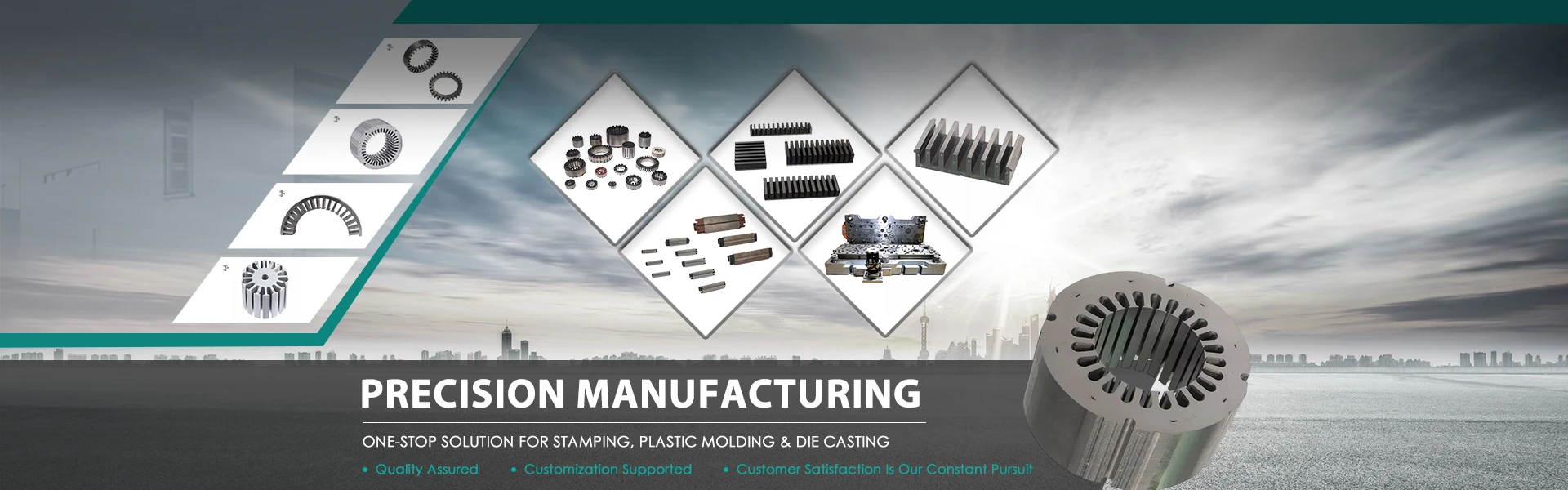
Application Areas of Metal Stamping Dies
Aug 04, 2026
Metal stamping dies are widely used in the machinery manufacturing and metal processing industries, primarily for operations such as blanking, bending, deep drawing, and forming sheet metal parts. Characterized by high production efficiency, favorable material utilization, and excellent dimensional consistency, stamping is particularly well-suited for mass production. By employing various types of stamping dies, manufacturers can produce metal parts in a wide range of shapes and sizes, laying the foundation for subsequent assembly and product manufacturing.
In the automotive sector, metal stamping dies are essential for producing body panels, brackets, reinforcement plates, and various structural components. Automotive parts often feature large dimensions, complex geometries, and stringent precision requirements, necessitating the design of specialized stamping dies tailored to the specific structure of each part. Similarly, in the home appliance and electronics industries, stamping dies are extensively used to manufacture casings, mounting brackets, connectors, terminals, and internal metal structural components. Although these parts vary in size and structure, they all demand high processing efficiency and dimensional consistency.
Metal stamping dies also find applications in fields such as mechanical equipment, telecommunications equipment, architectural hardware, instrumentation, and consumer hardware. Examples include connectors and supports for machinery, metal brackets and shielding components for telecommunications products, and metal connectors for the construction industry-all of which can be produced using stamping processes. Driven by advancements in automated production and precision machining technologies, stamping dies are evolving toward higher precision, efficiency, and automation, playing an increasingly vital role in modern industrial manufacturing.


