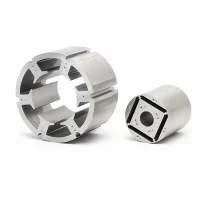
Working Principle Of Motor Hardware Components
Jul 07, 2026
Motor hardware components serve various functions-such as support, connection, fixation, magnetic conduction, and positioning-with specific parts performing distinct roles based on the motor's structure. During operation, components such as the motor housing, end shields, brackets, stator and rotor laminations, and various connectors form a cohesive mechanical structure that maintains the precise spatial alignment of internal parts. While these hardware components do not generate power directly, they ensure the assembly precision and structural stability required to provide a reliable mechanical foundation for the motor's proper functioning.
The stamped iron cores within the stator and rotor are critical hardware components; they form the magnetic circuit and work in conjunction with the windings to facilitate electromagnetic energy conversion. When the motor is energized, the stator windings generate a rotating magnetic field, and the rotor-driven by electromagnetic forces-produces torque and begins to rotate. Stator and rotor laminations are typically formed by stacking multiple silicon steel sheets to minimize eddy current losses during operation. Factors such as slot geometry, dimensions, and stacking precision directly influence winding installation and magnetic field distribution, necessitating high manufacturing accuracy.
End shields, brackets, and mounting hardware primarily provide structural support and positioning. Bearings housed in designated chambers support the rotor shaft and reduce rotational friction, while the end shields and housing work together to maintain the correct relative positioning between the rotor shaft and the stator. As motors generate vibration, heat, and mechanical loads during operation, these hardware components must possess sufficient strength, rigidity, and dimensional stability to prevent deformation or loosening that could compromise motor performance.
These various hardware components work in concert to create a stable mechanical and electromagnetic system. Dimensional accuracy, material properties, surface quality, and assembly precision all impact the motor's noise levels, vibration, heat dissipation, and service life. Consequently, the manufacturing process requires the selection of appropriate materials and fabrication techniques-including stamping, bending, punching, riveting, and assembly-to ensure component quality and meet the requirements for stable motor operation.