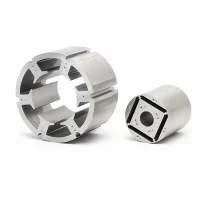
How is the quality of the iron core tested?
Aug 19, 2026
Quality inspection of the iron core primarily involves examining its appearance, dimensions, material properties, and operational performance to determine compliance with design and usage requirements. The process begins with a visual inspection to check for surface flatness and identify any obvious defects such as scratches, cracks, corrosion, impact damage, or deformation. For cores constructed from stacked silicon steel laminations, the alignment and tightness of the stack are also inspected to ensure there is no looseness, warping, or uneven edges. Significant mechanical damage to the core can impair the magnetic circuit and disrupt the normal operation of the equipment.
Next, dimensional and structural inspections are conducted. Tools such as vernier calipers and micrometers are used to measure the core's length, width, thickness, cross-sectional area, and mounting dimensions, which are then compared against engineering drawings or specified technical parameters. Significant dimensional deviations can affect coil installation and magnetic flux distribution. Therefore, in addition to measuring external dimensions, it is necessary to verify the core's shape, the integrity of connections between components, and the fit between the core and the coil.
Material properties and insulation performance are also critical aspects of quality inspection. Different equipment requires specific magnetic materials; for instance, silicon steel is commonly used in transformers. Material compliance with design requirements is verified based on material specifications and relevant test reports. For laminated cores, the quality of insulation between silicon steel sheets must be checked. Damaged inter-laminar insulation can lead to excessive eddy currents under alternating magnetic fields, resulting in increased core losses and abnormal heating. Insulation resistance testing is one method used to assess the core's insulation integrity.
Testing magnetic properties-such as permeability, magnetic flux density, coercivity, and core loss-is another vital method for evaluating quality. These parameters reflect the core's magnetic conductivity and energy loss during operation. Failure to meet magnetic performance standards can lead to issues such as magnetic saturation, increased losses, and temperature rise. For cores already assembled into equipment like transformers, operational performance can be assessed through no-load tests; measuring no-load current and no-load loss allows for comparison against specified values. Finally, checks regarding the mechanical and operational status must be performed. Once the core assembly is complete, verify that the core is tightly compressed and securely fixed, ensuring there is no looseness, vibration, or abnormal noise. During equipment operation, monitor the core's temperature; if localized overheating, abnormal vibration, or noise occurs, further inspection is required to check for issues such as looseness, insulation damage, or abnormal magnetic properties.